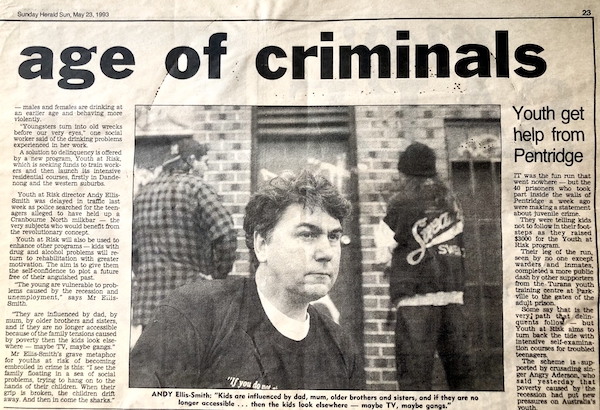
Enough is enough. It is time the age of young criminals was over. The newspaper clipping (pictured) is dated 23 May 1993. How much has changed since then?
In 2022–23, 48,014 young people aged 10–17 were proceeded against by police.
In 2023, crimes committed by 14 to 17-year-olds rose by 30%
In 2022–23, 4,542 people aged 10 and over were under youth justice supervision.
Enough is enough!
The media paints a devastating picture of a worsening youth crime but a closer look at the statistics reveal issues more complex than can be solved by a ‘lock ‘em up’ approach. Youth crime rates have for risen certain types of offences. Addressing the variations effectively – indeed, addressing all youth crime – requires a multifaceted approach.
We must consider that the significant proportion of youth crime committed by repeat offenders suggests that current intervention and rehabilitation programs may not be working. Solution: We need to effectively address the root causes of youth offending.
There is a shift in the motivations behind youth crime, suggested by the rise in crimes driven by the desire for social media notoriety. Solution: Targeted interventions are needed to address the role of social media in youth crime in Australia.
Crime rates in regional areas tend to be higher than in metropolitan areas. Solution: Region-specific strategies, indeed, community-specific strategies – are needed to address youth crime.
Programs struggle with persistent recidivism, both Qld-based tougher penalties, and community-based programs in NSW and Victoria, despite equal promise of effectiveness. Solution: implement a different strategy to combat youth crime.
The original Breakthrough Program in the USA was designed as a response to gang behaviour in some of the toughest neighbourhoods in the USA and the UK. Current programs continue in New York, USA, Stockholm, Sweden, Royston, UK, and Antwerp, Belgium with excellent results. Isn’t time this program addressed the problems in Australia?